A referral route with its own intake
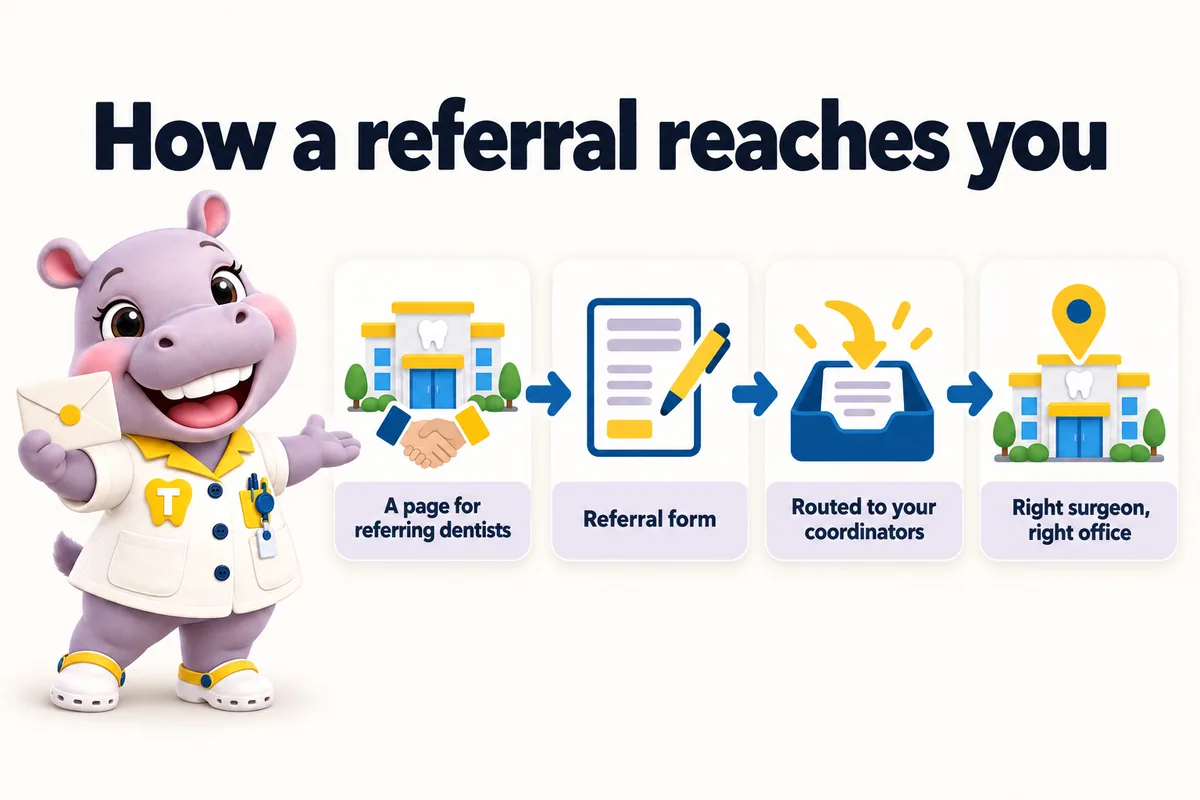
A page written for referring practices and an intake routed to your surgical coordinators rather than a shared inbox.
Service file
A referring general dentist and a self-referring patient arrive with completely different needs, and a site that treats them the same fails one of them. We build both routes: a referral path with its own page, its own intake and its own destination for the practices that send you cases, and a patient path that explains procedures as general information and ends at a consultation request. Both carry the office and the surgeon so nothing has to be worked out by phone afterwards.
What it costs
Referring practices are a distinct audience with distinct questions: what you need sent, how imaging should be transferred, which surgeon covers which procedure at which office, how quickly a case is acknowledged and who to call when something is urgent. Burying that inside a general contact page costs referrals, because a busy front desk at another practice will not hunt for it. We build a referral page that answers those questions plainly and an intake that collects what you actually need, routed to the destination your surgical coordinators use rather than the general inbox.
Referrals follow surgeons, and referred patients look up the name they were given before they call. A surgeon page with credentials, fellowship and board information, the offices they operate at, the procedures they cover and Person schema answers that search completely. It also gives referring practices something to link to, which is a link a general service page rarely earns. Because the page is linked to offices rather than living inside one, a surgeon covering a second location is a data change rather than a rewrite in three places.
Patients referred for extraction, implant placement or a biopsy arrive anxious and read carefully. The pages that help explain what the procedure involves in general terms, what happens on the day, what to arrange in advance, and what questions to bring, with cited sources and a clear statement that it is general information. We do not write recovery timelines presented as promises, complication rates, success rates or comparisons between surgeons or techniques. Anything specific to a patient goes to your surgeons, and both the page and the AI Engine hand it over rather than answering.
Surgical groups rarely have identical offices. One location has a surgical suite and sedation, another runs consultations only, a third is shared with a general practice two days a week. The site has to be truthful about that, or patients and referrers both end up in the wrong place. We hold capabilities per office, so the finder only offers a procedure at an office that actually performs it, the office page states what happens there, and a referral for something that office does not do is routed to one that does rather than bounced back.
Symptoms
Who it is for
Oral surgery practices and surgical groups that serve two audiences: referring dentists and patients referring themselves.
How the work is done
The same four steps for every service. The only thing paid before launch is the first month.
Pick a plan and pay the first month. That is the whole commitment; the $797 build fee waits until your site is live.
Thirty minutes with your operations lead: offices, providers, services, brand, where each office's requests should go, and hub or one site per location.
We design the site, write the pages, configure the finder for each office and connect each front desk. You review, we revise.
Your site goes live in 7, 10 or 15 days depending on the plan. Only then is the $797 build fee invoiced. Weekly updates start the same week.
Thirty minutes
We open a site built for a group like yours, walk the pages a patient would, and tell you which plan fits. Plans from $137 a month; the $797 build fee is invoiced after launch.
Deliverables
A page written for referring practices and an intake routed to your surgical coordinators rather than a shared inbox.
Credentials, fellowships, board information, the offices they operate at and the procedures they cover.
Surgical suite, sedation or consultation-only stated per location, so the finder never offers what an office cannot do.
What is involved, what happens on the day, what to arrange, with cited sources and no outcome or complication claims.
Office, surgeon, procedure interest and referral source attached, delivered to the system that office uses.
The number a referring practice should call, stated where they will actually look for it.
Risk reversal
Each promise is written with its condition in plain sight, so nothing is discovered after the invoice.
The $797 one-time build fee is invoiced after launch, once you have seen the site live and are happy with it.
Condition The first monthly fee is paid up front to start the plan.
Every page we build scores at or above the target on mobile and desktop at launch.
Condition If a page drops below it because of our work, we fix it at no charge and it does not use a revision.
The site starts ranking for local searches in your area within the window.
Condition If it has not, we keep working on it at no charge. We never promise a specific position.
Built in, not bolted on
A dental website carries obligations a brochure site does not. These ship with every plan, written for your practice and reviewed by you before launch.
These pages and practices help you meet common US requirements for a dental practice website. They are not legal advice, and we recommend your own counsel reviews the policies before launch. We are not a dental practice, dental group, dentist or healthcare provider, and we are not a law firm.
A privacy policy and site terms written around what your site actually collects, drafted for your review and your counsel's sign-off. Built with state privacy laws such as the CCPA in California in mind.
Analytics and marketing tags load only after a visitor agrees, and the cookie policy lists what the consent banner controls.
Real contrast ratios, visible focus states, keyboard navigation and alt text, built with the Americans with Disabilities Act (ADA) and WCAG 2.2 AA in mind, plus a statement telling patients how to report a problem.
Request forms are designed not to collect health information. That keeps the website out of your HIPAA scope as far as a website can be, while your intake system handles records.
Where a form or the AI Engine sends texts, consent wording sits next to the phone field, and we file the A2P 10DLC carrier registration for you on plans with the AI Engine.
Service pages and articles say they are general information, not a diagnosis or treatment plan, and send patients to your providers for anything about their own care.
Reviews
The preparation page for dental office selection works because it keeps its focus. It tells people what to have ready before we speak, without demanding everything up front. The link now goes out with our reply to every new inquiry.
Got Preparation guide and inquiry support for dental office selection
We shut at five-thirty. The dental office selection inquiries do not, and now the website copes with that. Evening visitors leave structured information and an honest response time, nothing more promised. The morning inbox is a work list now, not a puzzle.
Got After-hours inquiry capture for dental office selection
Out of scope
So nobody is surprised after ordering. Each of these is a deliberate line, not an upsell waiting to happen.
We do not write treatment recommendations, success rates, outcome claims or before-and-after captions. Your clinicians own every statement about care.
Request forms ask for a name, contact details, the office, the service and a preferred time. Medical history, insurance IDs and consent forms stay in your own intake system, never on the website.
We build pages that are fast and relevant enough to be good landing pages for your ads. Running and bidding on the campaigns themselves stays with you or your ads partner.
We route requests into the system or CRM each office already uses, by API, Zapier or Make. We do not sell, host or administer the practice software itself.
We use the office and team photos you own and have consent to publish, sized for their slots. Where you have none yet we use neutral, non-clinical images until yours arrive.
There are none. One fee covers every office in the group; extra revisions beyond 5 a month are a flat $20 each.
What's in each plan
What each feature does, the everyday problem it removes, what you have to do (usually nothing), and which plan carries it.
Cost
Referral forms with attachments, per-office routing and instruction pages are all inside the plan.
Timeline
Counted from the onboarding call, not from purchase. Revisions after launch are completed within 2 to 5 working days.
Case studies
No. 12General dentistry
When it comes to dental office selection, the good material existed internally and stayed there. Callers asked sensible questions the site could have answered but never did.
25 working days
No. 13General dentistry
For dental office selection, the team opened every morning to fragments: voicemails, bare emails, half-completed forms. Prioritising them required detective work before any real work.
10 working days
No. 14Cosmetic dentistry
With dental office selection, visitors re-entered correct information because the form would not say what was wrong. The less patient simply left.
15 working days
Yes. The referral intake collects the fields your coordinators need and routes them to the destination they work from. We do not store clinical records on the website; imaging and records are handed to the systems built to hold them.
Yes, and it is held as data rather than typed into pages. A surgeon covering a second office is one change that updates the surgeon page, both office pages, the procedure pages and the finder together.
We write general information about what a procedure involves and what to arrange in advance, with cited sources. We do not publish recovery timelines as promises, complication rates, success rates or technique comparisons. Anything specific is handed to your surgeons.
Capabilities are held per office, so the finder offers a procedure only at an office that performs it and the consultation-only location says clearly what happens there and where the procedure itself takes place.
It can answer routine questions such as hours, addresses and how to send a referral, on the plans that include it. It never gives dental or medical advice and hands anything clinical or urgent to a person at your practice.
No. Attachments are passed through with the request to the office's own system; the site does not store patient documents.
Yes. Instruction pages are written from what your surgeons supply, per procedure, with per-office differences noted and kept current as weekly detail updates.
Yes. A referrer page explains what to send, who handles what at which office and how quickly, with its own form.
A live walk-through of the site you would get, in about 30 minutes. Plans from $137 a month, the $797 build fee invoiced only after launch, domain and hosting included.
Book a demoOr email and a person replies within one working day.
ChairsideWeb uses the cookies below. Necessary cookies keep the site working and cannot be turned off.
Saved on this device only. Press Esc to close.