A ranking page for every office
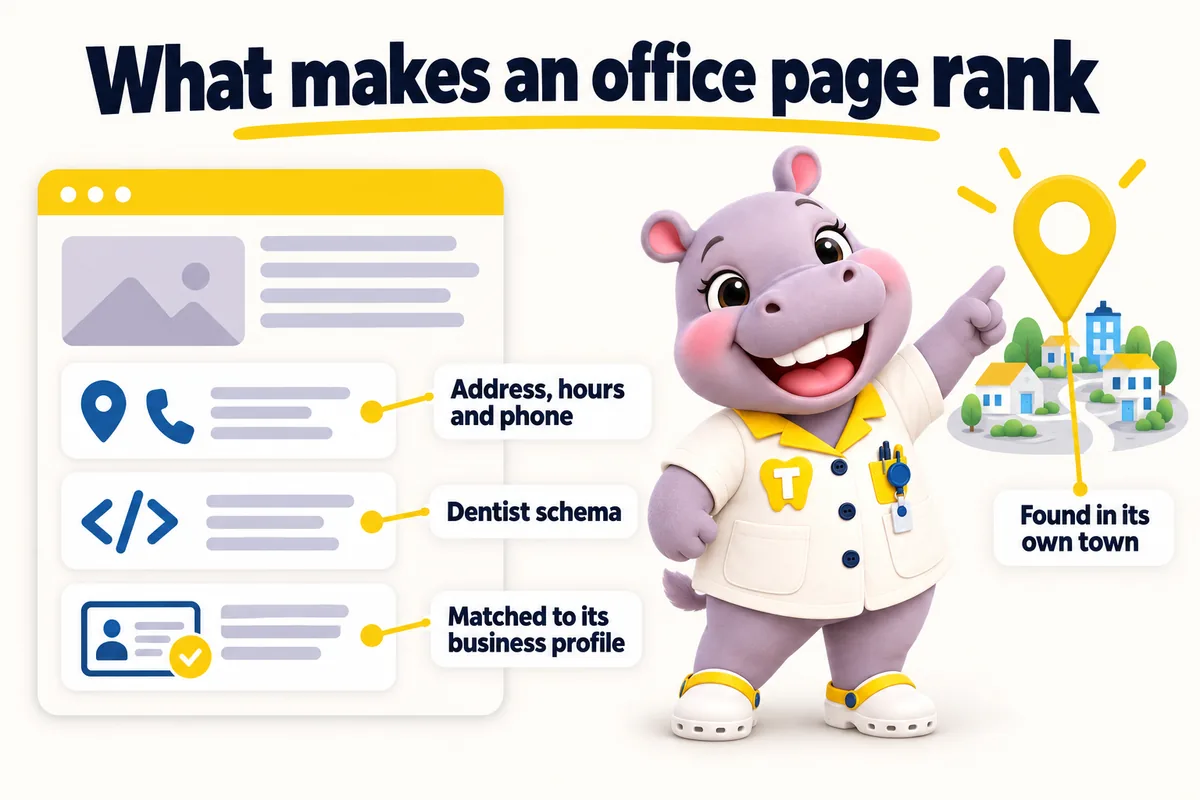
Own address, own hours, own phone, own providers, own services and its own Dentist schema.
Service file
Search engines rank pages, not groups, so an office without a page of its own cannot rank for its own town no matter how good the group site is. The structural work is therefore first: one page per office with its own address, hours and Dentist schema, service pages linked to the offices that offer them so they do not compete with each other, and provider pages with Person schema tied to their locations. Content sits on top of that and compounds. Without it, content is being poured into a site that cannot hold it.
What it costs
An office page needs the things a patient checks and a search engine reads: the full address, the hours including the awkward ones, the phone number that reaches that desk, the parking and entrance notes, the providers on site, the services offered there and the insurance accepted. All of it is held per office and emitted as Dentist schema, and all of it is matched to that office's Google Business Profile so the two agree. Disagreement between a website and a profile is one of the most common and most fixable problems we find in a group audit.
The usual group mistake is a service page per office per service, which produces near-identical pages competing for the same phrase and splitting whatever authority the group has. We write the service page once at group level, properly, and link it to the offices and providers that offer it. Each office page in turn lists the services available there. A patient can arrive from either direction and reach a booking request, and search engines get one strong page per service instead of seven weak ones. Where an office genuinely does something different, that difference gets its own section rather than its own duplicate page.
Patients search for clinicians by name, especially specialists and anyone who has been referred. A provider page with Person schema, the offices they work at, the services they offer and their credentials answers that search and gives every office another way in. It also handles the group reality that clinicians move: because the page is linked to offices rather than living inside one, a provider changing locations is a data change rather than three page rewrites. Referring practices tend to link to provider pages too, which is the sort of link a service page rarely earns.
On a hub, an article works for every office at once, which is the strongest argument for that structure. We publish researched articles every week, each with cited sources, each linking to a service page, the relevant provider pages and the finder, so a reader who arrives on an article is one click from a booking request at the nearest office. Articles are general information for patients and families rather than advice, and they never carry outcome claims or success rates. Where an article is genuinely about one office, it is scoped and linked to that office.
Who it is for
Groups whose flagship ranks but whose other offices do not, and groups that want to be cited by AI assistants as well as search engines.
Local search works the same way whether an office is in Texas, Florida, California, New York, Illinois and Georgia: each office needs its own page for its own town.
Symptoms
Deliverables
Own address, own hours, own phone, own providers, own services and its own Dentist schema.
Structured data comes from the office record, so a page and its schema can never drift apart.
Written once at group level and linked to the offices that offer them, instead of duplicated per location.
Tied to the offices each clinician works at, so a move is a data change rather than three rewrites.
Website hours, address and phone matched to each office's Google Business Profile, and kept matched weekly.
With cited sources, linked to a service, the providers who offer it and the finder. General information, never advice.
New offices, providers, services and articles appear in the sitemap and the internal link graph automatically.
Risk reversal
Each promise is written with its condition in plain sight, so nothing is discovered after the invoice.
The $797 one-time build fee is invoiced after launch, once you have seen the site live and are happy with it.
Condition The first monthly fee is paid up front to start the plan.
Every page we build scores at or above the target on mobile and desktop at launch.
Condition If a page drops below it because of our work, we fix it at no charge and it does not use a revision.
The site starts ranking for local searches in your area within the window.
Condition If it has not, we keep working on it at no charge. We never promise a specific position.
Built in, not bolted on
A dental website carries obligations a brochure site does not. These ship with every plan, written for your practice and reviewed by you before launch.
These pages and practices help you meet common US requirements for a dental practice website. They are not legal advice, and we recommend your own counsel reviews the policies before launch. We are not a dental practice, dental group, dentist or healthcare provider, and we are not a law firm.
A privacy policy and site terms written around what your site actually collects, drafted for your review and your counsel's sign-off. Built with state privacy laws such as the CCPA in California in mind.
Analytics and marketing tags load only after a visitor agrees, and the cookie policy lists what the consent banner controls.
Real contrast ratios, visible focus states, keyboard navigation and alt text, built with the Americans with Disabilities Act (ADA) and WCAG 2.2 AA in mind, plus a statement telling patients how to report a problem.
Request forms are designed not to collect health information. That keeps the website out of your HIPAA scope as far as a website can be, while your intake system handles records.
Where a form or the AI Engine sends texts, consent wording sits next to the phone field, and we file the A2P 10DLC carrier registration for you on plans with the AI Engine.
Service pages and articles say they are general information, not a diagnosis or treatment plan, and send patients to your providers for anything about their own care.
Reviews
We handed over a folder of our real dental office selection replies and let them work from that. The recurring questions were pulled out, rewritten clearly, and approved line by line by our team. The phone calls about basic dental office selection details have noticeably thinned out.
Got FAQ research and editorial review for dental office selection
The review of our dental office selection pages was uncomfortable reading, in a useful way. The facts have one home, and every change request names the reference page and its reviewer. Customers no longer quote wording we retired two years ago.
Got Content audit and update process for dental office selection
The old dental office selection address sits in hundreds of our sent messages; breaking it was not an option. The redirect plan was presented for our approval like any other deliverable. Not one 'your link is broken' message arrived after launch.
Got Page migration and redirect mapping for dental office selection
Out of scope
So nobody is surprised after ordering. Each of these is a deliberate line, not an upsell waiting to happen.
We do not write treatment recommendations, success rates, outcome claims or before-and-after captions. Your clinicians own every statement about care.
Request forms ask for a name, contact details, the office, the service and a preferred time. Medical history, insurance IDs and consent forms stay in your own intake system, never on the website.
We build pages that are fast and relevant enough to be good landing pages for your ads. Running and bidding on the campaigns themselves stays with you or your ads partner.
We route requests into the system or CRM each office already uses, by API, Zapier or Make. We do not sell, host or administer the practice software itself.
We use the office and team photos you own and have consent to publish, sized for their slots. Where you have none yet we use neutral, non-clinical images until yours arrive.
There are none. One fee covers every office in the group; extra revisions beyond 5 a month are a flat $20 each.
What's in each plan
What each feature does, the everyday problem it removes, what you have to do (usually nothing), and which plan carries it.
Cost
SEO structure, schema and 2 articles a week are in every plan; the Group plan adds a third article and managed Google Business Profiles. We do not sell link-building or ranking packages.
Timeline
Counted from the onboarding call, not from purchase. Revisions after launch are completed within 2 to 5 working days.
How the work is done
The same four steps for every service. The only thing paid before launch is the first month.
Pick a plan and pay the first month. That is the whole commitment; the $797 build fee waits until your site is live.
Thirty minutes with your operations lead: offices, providers, services, brand, where each office's requests should go, and hub or one site per location.
We design the site, write the pages, configure the finder for each office and connect each front desk. You review, we revise.
Your site goes live in 7, 10 or 15 days depending on the plan. Only then is the $797 build fee invoiced. Weekly updates start the same week.
Thirty minutes
We open a site built for a group like yours, walk the pages a patient would, and tell you which plan fits. Plans from $137 a month; the $797 build fee is invoiced after launch.
Case studies
No. 03General dentistry
Day to day with dental office selection, dependable answers existed, but only inside old email chains. Visitors called about simple matters, and new staff had no reference to check their wording against.
20 working days
No. 09Endodontics
For dental office selection, callers quoted retired wording with total confidence. Staff could not answer safely without first asking which page the caller had open.
10 working days
No. 15General dentistry
Day to day with dental office selection, the business faced a choice between keeping a structure that no longer fitted and breaking links it could not count.
20 working days
No, and nobody honestly can. Our guarantee is that the site starts ranking for local searches in your area within 3 to 5 months, and if it does not we keep working at no charge. We will never quote you a position or an invented traffic figure.
On the Group plan we manage each office's profile and keep it in step with its page. On the other plans we make sure the website matches what your profiles already say, and tell you where they disagree.
On a hub, no. One blog serving the group compounds, and articles are linked to the offices and services they are about. On separate sites each site carries its own, which is one of the real costs of that structure.
By not writing it. Service pages exist once and link to the offices that offer them. Office pages carry genuinely local content: their address, their hours, their team, their parking, their insurance. Nothing is spun per location.
No. Every article is general information and says so. It explains what a procedure involves, what to ask and how to book, and points the reader to your providers for anything about their own situation.
AEO, answer engine optimization, means structuring pages so they can be lifted into featured snippets and voice answers. GEO, generative engine optimization, means making facts clear and consistent so AI assistants such as ChatGPT, Claude, Perplexity and Google AI Overviews can cite them. Both are built into every page.
Each office page gives search engines something to show for that office's own town, with the address, hours, providers and schema that local results rely on. We guarantee the site starts ranking for local searches within the stated window, never a position.
No. Pages for towns without an office are thin doorway pages that search engines filter out. We build one strong page per real office.
A live walk-through of the site you would get, in about 30 minutes. Plans from $137 a month, the $797 build fee invoiced only after launch, domain and hosting included.
Book a demoOr email and a person replies within one working day.
ChairsideWeb uses the cookies below. Necessary cookies keep the site working and cannot be turned off.
Saved on this device only. Press Esc to close.